
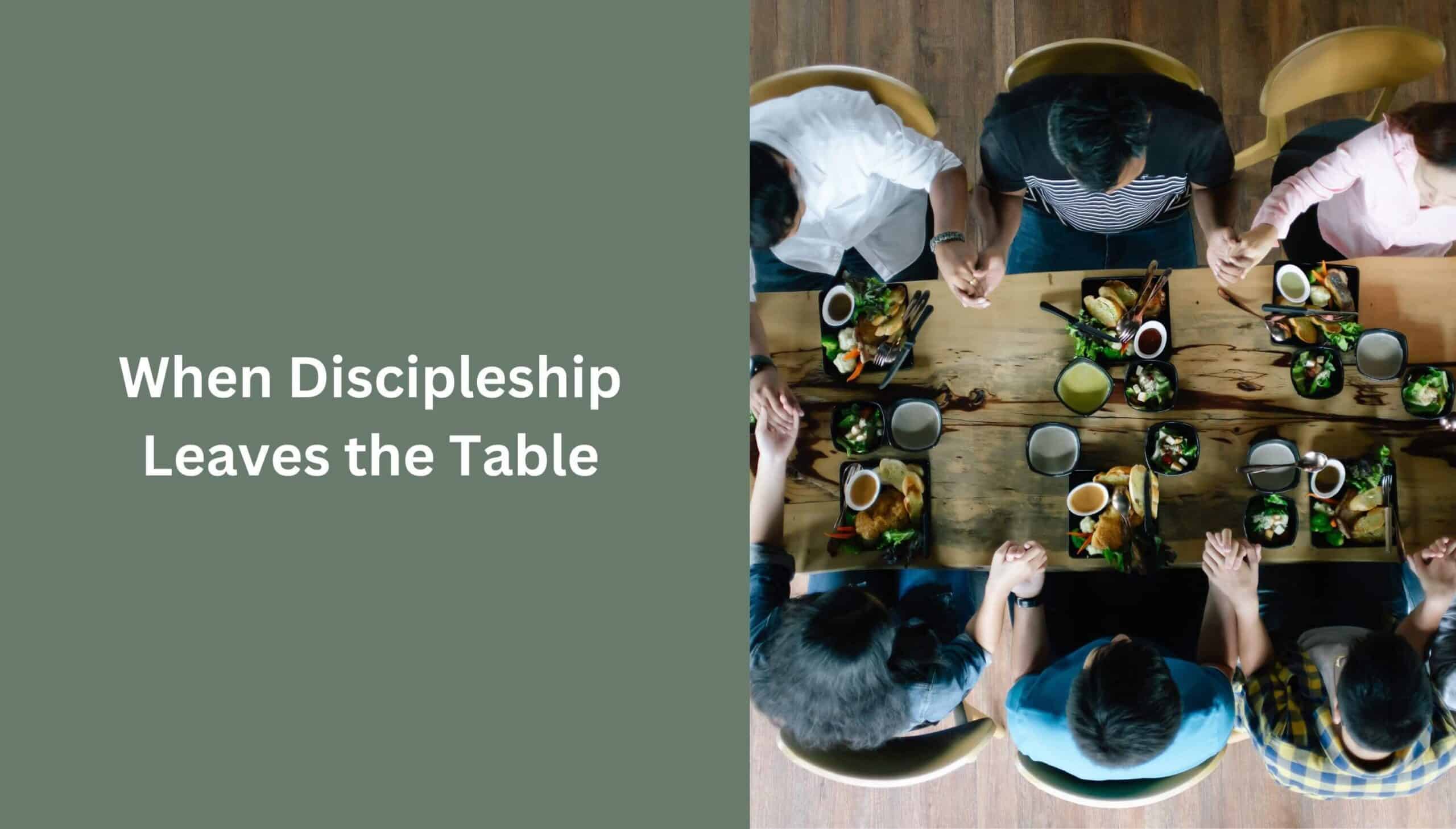
Jesus was known for many things—but one of them was this:
He kept showing up at tables.
He ate with His disciples.
He was accused of eating with sinners.
He sent His followers
into the homes of others—
to sit,
to receive,
to stay.
Discipleship, in His way,
happened around tables.
Not a church event.
Not as a program.
But as shared life.
The Table Environment
At the table,
people were known.
Conversations wandered.
Questions surfaced.
Stories were told and retold.
Correction happened naturally.
Obedience was immediate.
Faith was visible.
The table held something
no program could manufacture—
proximity.
The Drift Away
But slowly, almost without noticing,
we moved discipleship
away from the table.
Into buildings.
Into programs.
Into scheduled events.
And with each step away,
something changed.
For every degree
we move discipleship away
from everyday spaces
and organic relationships,
we lessen its power.
What Gets Lost
The moment discipleship leaves the table,
it starts losing its power.
Vulnerability fades—
because people perform
more easily than they open up.
Authenticity thins—
because environments
begin to shape expectations.
Participation narrows—
because a few speak
while many listen.
And over time,
discipleship becomes something
people attend—
rather than something they live.
Why the Table Multiplies
Tables multiply
because they are simple.
Everyone has access.
Everyone knows how to sit,
to eat,
to talk,
to listen.
No special training required.
No building needed.
Just people
and a willingness
to share life.
What people experience
in these spaces,
they can repeat.
And what can be repeated,
can multiply.
Returning to the Table
This is not a rejection of teaching.
It is a re-centering.
Teaching belongs
inside relationship—
not in place of it.
And often, this means more than inviting people
into our spaces of comfort.
It means stepping into theirs—
sitting at their tables,
in their homes,
within their rhythms of life.
Because discipleship deepens
when it happens
where people are most at ease—
not where we are most in control.
If we want discipleship
that actually forms people
and multiplies through others,
we must bring it back
to everyday life.
Back to homes.
Back to conversations.
Back to tables.
Food For Thought
What are you modeling for those in your host culture?
Where does your discipleship live?
In a program?
In a building?
In an event?
Or in the shared lives
of people
walking together
and learning to follow Jesus
side by side?
Keep Exploring
Take the next step with Five Stones Global—access trainings and tools designed to help you
build discipleship that is relational, reproducible, and ready to multiply.