How good intentions can quietly weaken local ownership and multiplication
Imagine This
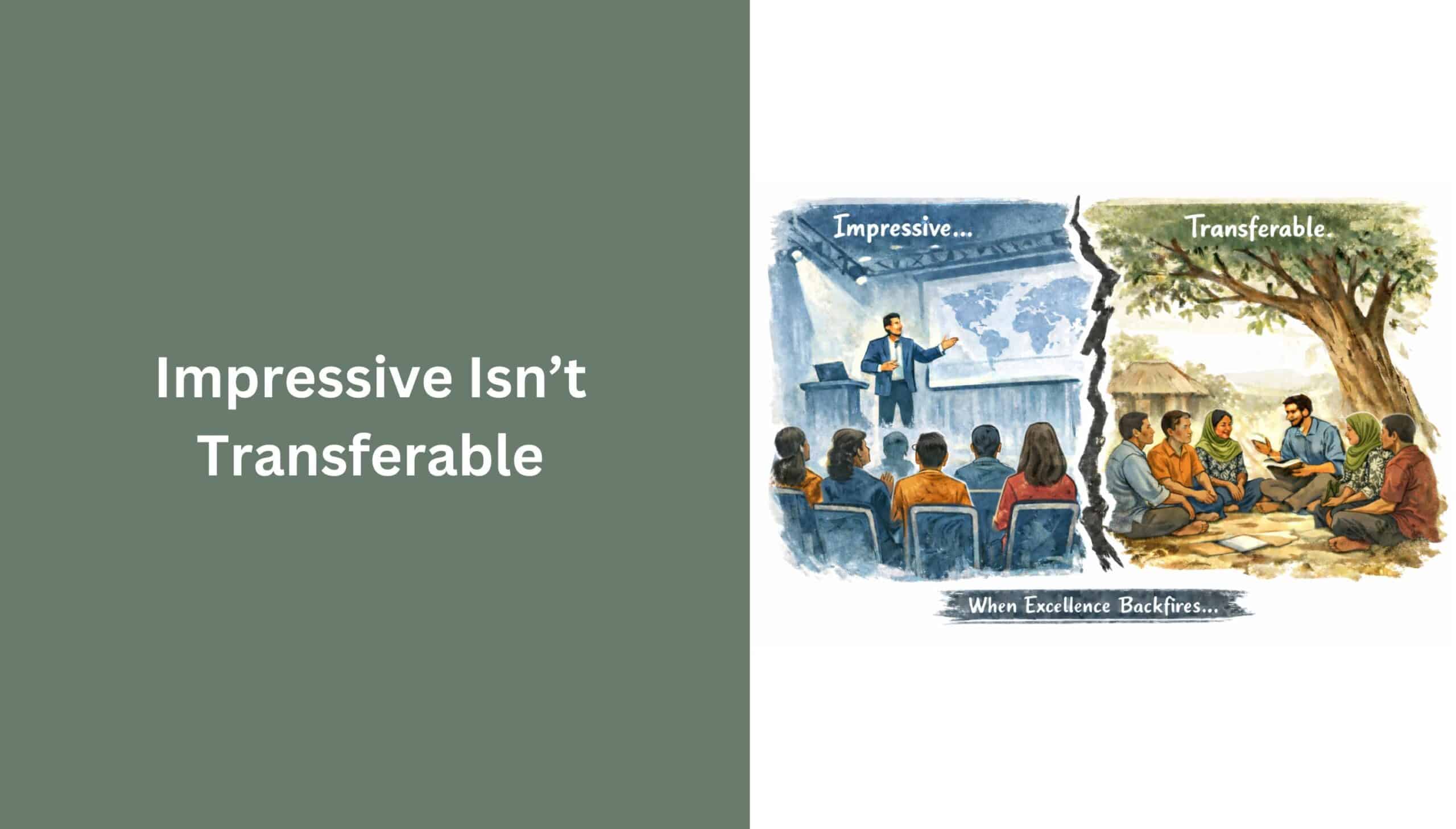
A team comes to train local believers. The teaching is clear. The resources are high quality. The schedule runs smoothly. Everyone leaves encouraged.
Later, local people say:
“That was amazing… we could never do it like that here.”
That sentence sounds humble.
But it’s a warning light.
Because discipleship is not meant to be impressive.
It’s meant to be transferable.
Most of us didn’t come to the nations to build dependence. We came to serve—to see disciples multiply, churches strengthened, and communities encouraged. But sometimes the very strengths we bring—organization, training skills, theological clarity, systems, resources—can quietly create the opposite result: people begin to rely on us instead of growing in confidence and ownership themselves.
It’s not because we’re trying to be the hero.
It’s because Western excellence is powerful.
And power always shapes outcomes.
What Local Dependence Looks Like (Real-World Signals)
Dependence doesn’t usually look like someone saying, “We depend on you.”
It looks like patterns.
Here are a few warning signs we may be helping in ways that don’t multiply:
1) People wait for outsiders to lead
Local believers participate, but they don’t initiate.
They wait for the next visit, the next plan, the next lesson.
2) The “best” ministry happens only when the outsider is present
When the outsiders arrive, everything comes alive.
When they leave, it fades.
3) The local version is viewed as “second best”
A local leader teaches a story simply, and people feel apologetic.
But the globalworker teaches with polish, slides, and structure—and people feel impressed.
4) Leaders multiply skills slowly (or not at all)
Lots of ministry activity, but not much reproduction.
The work becomes event-based instead of apprenticeship-based.
5) Resources create a hidden gap
Materials, money, tech, and time create an invisible comparison standard:
“If we can’t do it like that, we can’t do it.”
Why This Happens
Here’s the hard part: Western tools don’t just help—they shape the room.
Along with them come quiet assumptions about what “good ministry” looks like. We begin to assume:
- Credibility = professionalism
- Effectiveness = speed
- Learning = information transfer
- Success = big gatherings
- Leadership = the expert
- Readiness = a polished product
Many cultures don’t learn or lead that way.
In many non-Western cultures, people form convictions through:
- relationship
- repeated story
- community practice
- honor and shame
- apprenticeship
So if we lead through outsider strength, we may unintentionally train people to stay in the passenger seat.
The “Good Gift” That Becomes a Burden
Western excellence becomes dangerous when it creates:
- admiration without ownership
- inspiration without imitation
- consumption without reproduction
Or to say it more bluntly:
If locals can’t reproduce what we’re doing without us, then we didn’t train—we performed.
The Pivot: A Different Kind of Excellence
What should we aim for instead?
Not lower quality.
Not sloppiness.
Not “anything goes.”
But a different kind of excellence.
Excellence that measures success by:
- local ownership
- simple reproducibility
- faithful obedience
- leaders who can train others
- methods that fit the culture
- gospel clarity that doesn’t require outsiders
At Five Stones Global, we often describe it like this:
Jesus-Centered
Culturally Effective
Simply Reproducible
Five Practical Shifts That Reduce Dependence
These are small adjustments that change everything.
1) Move from “teaching” to apprenticeship
Don’t just deliver content.
Train people to do the thing while you’re still there.
Model → Assist → Watch → Launch
2) Make it normal for locals to lead early
Let it be imperfect.
Let it be local.
Let it be theirs.
Early ownership is more valuable than polished delivery.
3) Design for low-resource replication
If your method requires:
- printed manuals
- technology
- a gifted teacher
- hours of prep
…it may not multiply.
Aim for tools people can carry in their memory, not their backpack.
4) Validate local expressions of worship and leadership
If you always bring the songs, the structure, the “best way,”
you may accidentally silence local voices.
5) Measure fruit long after you leave
Short-term fruit: “They loved it!”
Long-term fruit: “They’re doing it without us.”
That’s the real win.
We’re Learning Too
Most of us were trained to equate excellence with faithfulness.
But cross-culturally, excellence has to be redefined.
Sometimes the most faithful thing we can do is to step back—
so local believers can step forward.
Because the goal was never to build something that needs us.
The goal is disciples who can obey Jesus, share Jesus, and multiply—
in forms that belong to their community.
Reflection Question
What’s one part of global or cross-cultural work that works well only when you’re present—and what would it look like to redesign it so local people can perpetuate it on their own?
Next Steps (If This Hit Close to Home)
If you’ve ever heard, “We could never do it like that here,” you’re not alone. We’ve built training tools to help teams redesign for local ownership:
- Day 1 Affects Day 100 – building sustainable disciple-making rhythms and strategy over time
- We Are Not the Hero – identifying hidden paternalism and shifting toward healthy partnership
- Not With Ink – equipping teams for story-based, worldview-intentional disciple-making that multiplies
Want help choosing the right fit? We’ve put all our trainings in one place so you can quickly find what fits your team and setting.